
September 2021
Plan Sponsor
News
Welcome to the September issue of Plan Sponsor News! In this month’s newsletter, learn about the benefits of automatic enrollment, get a refresher on RMD updates, and find out if your participants are eligible for an income-based tax credit.

The Benefits of Automatic Enrollment
Automatic Enrollment helps streamline retirement contributions, benefiting both participants and plan sponsors.
By offering a company-sponsored retirement plan, your organization is taking an important step toward helping your employees prepare for a more financially secure future. If you are offering an employer-sponsored 401(k) or 403(b) plan with salary-reduction contributions, then you currently have the option to add an Auto-Enrollment feature to your existing plan, which can drive more participation and deepen employee engagement.

What is Auto-Enrollment?
Auto-Enrollment is a tool that you can use to help ensure your employees are taking advantage of the benefits your company offers by automatically enrolling them in your retirement plan. With this feature, employees are not required to take action to contribute to their retirement plan or even decide what percentage of their salary to contribute. Auto-Enrollment takes the initial guesswork out of participating in the plan, while still allowing employees to adjust their per-paycheck contributions or to opt out if they decide to.
How does it work for new employees?
When a new employee is onboarding, they’re automatically enrolled in the organization’s retirement savings plan, and a predetermined percentage or dollar amount (set by their employer) is taken out of each paycheck and deposited into the employee’s retirement account, in a pre-selected investment option (also known as a Qualified Default Investment Alternative). Employees have the opportunity to opt out of the plan at any time. Depending on the type of automatic enrollment arrangement, participants may be able to have automatically contributed salary deferrals returned if they request them within 90 days of their initial enrollment. They can also adjust their contribution amount or investment allocation at any time.
How does this impact existing employees?
Should you decide to add Auto-Enrollment to your company’s retirement savings plan, it can include existing eligible employees who are not currently participating or are contributing below the default deferral rate. As with new employees, existing employees will have a predetermined per-paycheck salary-reduction contribution deposited into their retirement savings account, until they choose to either modify that amount or to opt out of the program.
What are the benefits?
Auto-Enrollment can help your employees lay the foundation for a secure retirement. According to a survey by the Plan Sponsor Council of America, plans that auto-enroll employees have participation rates of over 88% compared to an average of 52% participation for “opt-in” plans.
But Auto-Enrollment doesn’t just help employees. Organizations can also benefit through simplified administration, possibly lower plan fees, smoother compliance testing and potential tax credits. This feature can also be used in recruiting and retaining employees.
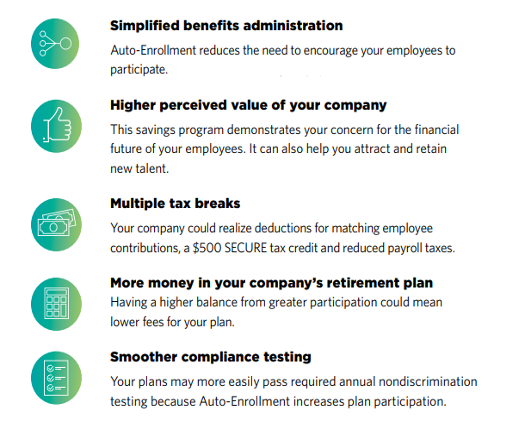
Mutual of America’s Auto-Enrollment tool can help take the stress out of retirement planning and administration today, while helping set up your company and its employees for long-term success. To learn more about Auto-Enrollment and how it can help you, get in touch with your local Mutual of America representative.
The tax information contained herein is for informational purposes only. You should consult your financial adviser or attorney regarding your individual circumstances.
Better your tomorrow.
Contact your Mutual of America representative today.
Required Minimum Distributions Update
Following are current requirements regarding RMDs.
When the Coronavirus Aid, Relief, and Economic Security (CARES) Act was signed into law in March 2020, it suspended required minimum distributions (RMDs) from defined contribution plans (like 401(k) and 403(b) plans), and IRAs in 2020 to taxpayers who would have been otherwise required to take RMDs. That suspension ended on December 31, 2020.

Current RMD Requirements
The Internal Revenue Code generally requires retired individuals to begin taking annual withdrawals from their employer-sponsored defined contribution retirement plan after they reach age 72 (age 70½ if born before June 1, 1949). The exception to this is if they are a 5% owner of the business sponsoring the plan, in which case their RMDs will begin even if they are still working.
In general, RMDs from Traditional IRAs, including SEP and SIMPLE plans, must be taken by individuals by April 1 of the following calendar year in which they turn 72, even if they are still working.
If you have any questions about RMDs, please contact your local Mutual of America representative.
Better your tomorrow.
Contact your Mutual of America representative today.
Saver’s Credit for 2021
Helpful information to know about a tax credit available for certain taxpayers.

Employees who contribute to a 401(k), 403(b), governmental 457 or SIMPLE IRA plan, or to a traditional or Roth IRA, might be able to take advantage of the Saver’s Credit, a tax credit of up to $1,000 ($2,000 if married filing jointly) for certain taxpayers.
The credit is equal to 50%, 20% or 10% of an individual’s contribution, depending on his or her adjusted gross income. The table below shows the income limits to claim the credit for 2021.
This and other important information is provided by us to your employees through our Retirement Insights newsletter and on our website, mutualofamerica.com.
If you or your employees have questions about the Saver’s Credit or saving for retirement, please call your local Mutual of America representative today.
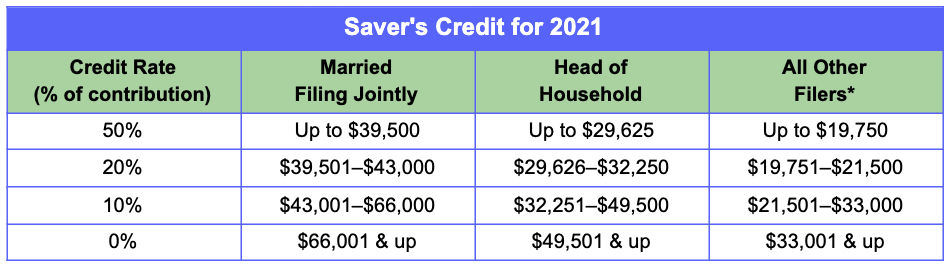
*Single, married filing separately or qualifying widow(er).
The tax information contained herein is for informational purposes only. You should consult your financial adviser or attorney regarding your individual circumstances.
Better your tomorrow.
Contact your Mutual of America representative today.

Things
to know
1
Summary Annual Report
A Summary Annual Report (SAR) must be distributed to participants two months after the plan’s Form 5500 filing. For calendar-year plans (i.e., plans that have January 1 as the first day of the plan year), the deadline is September 30, or two months after the regular Form 5500 filing deadline of July 31. If an employer has received a Form 5500 filing extension, the deadline for the SAR is likewise extended. For calendar-year plans, the extended Form 5500 deadline is October 15. The SAR deadline would be extended by two months to December 15.
2
42%
Percentage of workers currently participating in a workplace retirement savings plan who have actively chosen their investments.
*2021 Retirement Confidence Survey. Figure 4. EBRI/Greenwald Research Retirement Confidence Survey. April 2021.
3
In Case You Missed It: Economic Update
Check out Mutual of America Capital Management LLC Chairman and CEO Stephen Rich’s latest Economic Perspective here for a market snapshot and outlook for the rest of 2021.