
July 2022
Plan Sponsor News
|
Welcome to the July issue of Plan Sponsor News! In this quarterly newsletter, we provide resources to boost your employee’s financial wellness and educate them about ESG investing. We’re also very excited to recognize the 2021 Community Partnership Award winners!
|

Focus on Financial Wellness Initiatives

Promoting employee financial wellness is increasingly important among today’s employers. According to the 2021 EBRI Financial Wellbeing Employer Survey, the number of companies actively implementing financial wellness initiatives last year grew to more than one-third (34%), up from just 12% in 2018.1
In doing so, employers are looking to improve overall worker satisfaction, increase employee productivity and reduce employee financial stress.2 To that end, companies are designing initiatives to address top issues facing employees, including:3
- Retirement preparedness (36%)
- Financial-related stress (30%)
- Budgeting and money management (26%)
- Debt (17%)
- Daily living expenses (14%)
Financial planning education, seminars or webinars are the most common financial wellness benefit, with more than half of employers surveyed (55%) offering such an initiative. Additionally, half (50%) provide basic money management tools or employee discount programs/partnerships.4
Mutual of America offers customizable financial education services through one-on-one interactions and group meetings to help your participants feel more confident in their financial choices. If you have questions about incorporating financial wellness initiatives for your employees, talk to your Mutual of America representative.
1EBRI Issue Brief, No. 544. “2021 EBRI Financial Wellbeing Employer Survey: Focus on COVID-19 and Diversity Goals.” Page 6, Figure 1. Employee Benefit Research Institute. October 28, 2021.
2EBRI Issue Brief, No. 544. “2021 EBRI Financial Wellbeing Employer Survey: Focus on COVID-19 and Diversity Goals.” Page 20, Figure 24. Employee Benefit Research Institute. October 28, 2021.
3EBRI Issue Brief, No. 544. “2021 EBRI Financial Wellbeing Employer Survey: Focus on COVID-19 and Diversity Goals.” Page 9, Figure 6. Employee Benefit Research Institute. October 28, 2021.
4EBRI Issue Brief, No. 544. “2021 EBRI Financial Wellbeing Employer Survey: Focus on COVID-19 and Diversity Goals.” Page 15, Figure 16. Employee Benefit Research Institute. October 28, 2021.
Better your tomorrow.
Contact your Mutual of America representative today.
Understanding the Basics of ESG Funds

Driven by changing social norms, there is a heightened sense of awareness and urgency to combat climate change and social inequality. ESG funds allow your organization to provide a vehicle for your employees to see their views incorporated into traditional investment portfolios. We asked Joni Clark, CFA, CFP, CRPS, and Andrew Kramer, CFA, of 320 Park Analytics, LLC, to answer some questions we frequently hear from plan sponsors.
Q: What is ESG investing?
Joni Clark: ESG (Environmental, Social, Governance) is an umbrella term to define a range of investment strategies that considers the environmental impact and/or social policies of a company as part of the investment selection process. You will see many different terms used to describe investments within the ESG category, including sustainable, socially responsible, green and impact, and faith-based investment strategies such as Catholic Values funds.
Q: What are the different approaches to ESG investing?
Andrew Kramer: There are three primary approaches used by ESG funds. The first is known as Restrictive Screening. This uses exclusionary, values-based filters to screen out certain companies or industries based on social or environmental issues. For example: faith-based strategies, such as Catholic Values, use a negative screening approach to avoid the “sin stocks” (i.e., those companies with revenues generated from the production or sale of alcohol, weapons, tobacco, adult entertainment or gambling).
The second is called Impact Investing. This proactively targets specific ESG issues through investment and shareholder engagement.
Finally, ESG Incorporation considers traditional, fundamental research in the investment process.
Q: Can you describe the components of ESG incorporation?
Joni Clark: ESG incorporation systematically integrates ESG considerations (environmental themes, social standards and governance practices) with traditional investment analysis.
- Environmental criteria focus on how a company’s business practices affect natural resources, the climate and other aspects of the environment.
- Social criteria look at a broad range of company policies such as a company’s commitment to inclusion and diversity in the workplace, labor rights, product safety and the relationships with the communities where they conduct business.
- Governance pays close attention to board diversity and compensation, political donations, business ethics and board-level attention to sustainability and climate issues.
Q: Is there a wide variety of ESG funds to choose from?
Joni Clark: ESG investment options now exist in all market segments, including U.S. and international equity, and different capitalization segments of the equity market and fixed income. So, it is possible for an investor to properly diversify their investments while still adhering to their ESG philosophy.
Q: What issues should an organization be aware of in choosing ESG funds?
Andrew Kramer: First, ESG factors can be applied to any asset class, so understand the style of the fund in your organization’s plan lineup.
Second, some ESG-type funds may be concentrated in the number of stock holdings and/or have concentration in a specific sector. Analyze the overall investment process of the fund.
Third, there is a lack of standards comparing a company’s ESG metrics, which makes it hard to compare ESG metrics from one fund to another.
Fourth, if you are a plan fiduciary to a retirement plan covered by ERISA, you should know that ESG funds have come in and out of favor with government regulators. We seem to be in a period in which regulators are encouraging ESG-type considerations; but that has not always been the case, and may not be the case in the future. It’s just one more reason that plan fiduciaries need to monitor their investment lineups to be ready to make changes, if necessary, to fulfill their fiduciary obligations to the plan and its participants and beneficiaries.
Q: What does the future hold for ESG investing?
We expect to see many developments in ESG investing in the coming years to improve both the transparency of ESG risks among companies, and the consistency of ESG metrics and approaches used by investment managers.
The SEC is proposing ESG disclosure requirements for publicly traded companies, which will improve transparency and allow for better comparisons across individual companies. More consistent standards for the integration of ESG factors in the investment process have also been proposed to help prevent greenwashing and allow investors to more easily compare ESG investment options. These developments should help the industry to grow by instilling more confidence in ESG investing.
Economic & Market Perspective Webinar

Stephen J. Rich, Chairman and CEO
Mutual of America Capital Management LLC
In the latest installment of Mutual of America’s Economic & Market Perspective webinar series, Stephen J. Rich, Chairman and CEO of Mutual of America Capital Management LLC, delves into how inflation, rising interest rates and global uncertainty around the war in Ukraine have affected investors, and what might be on the horizon.
Better your tomorrow.
Contact your Mutual of America representative today.
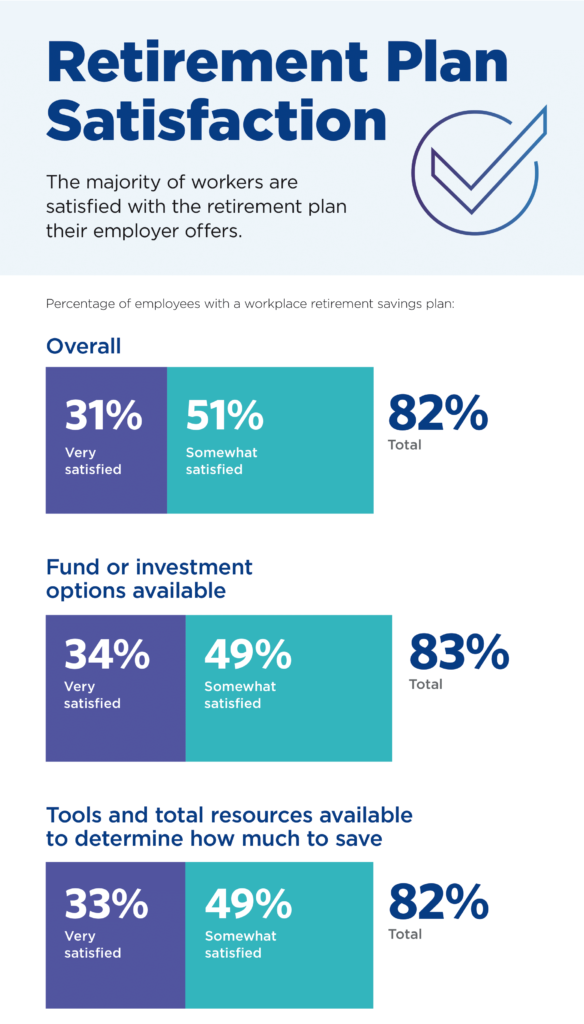
EBRI/Greenwald Research. April 2022.
Things
to know
1
Community Partnership Award Celebration
On May 10, Mutual of America Financial Group recognized five nonprofit organizations as recipients of its 2021 Community Partnership Award during a special event at its Company headquarters in New York City.
The New York City-based Center for Alternative Sentencing & Employment Services’ (CASES) Nathaniel Project received the Thomas J. Moran Award, which is given to the national award-winning program and includes $100,000 and a documentary video about the program, produced by Mutual of America.
Click here to learn more about the 2021 Community Partnership Award.
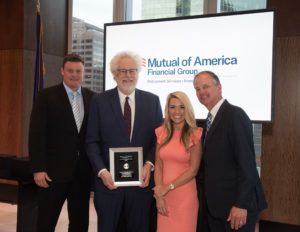
(Second from left) Joel Copperman, CEO/President, CASES, with (from left) Brian Severin, Senior Executive Vice President and CMO, Mutual of America Financial Group; Lisa Loughry, Chair, President and CEO, Mutual of America Foundation; and John Greed, Chairman, President and CEO, Mutual of America Financial Group.
2
401(k) assets
The majority of 401(k) participants’ assets—68%—were invested in stocks at the end of 2019. This includes equity funds, the equity portion of balanced funds, and company stock.
EBRI Issue Brief, No. 557. “401(k) Plan Asset Allocation, Account Balances, and Loan Activity in 2019.” Employee Benefit Research Institute. May 3, 2022.
3
Nearly 8 million
The number of small businesses—employers with fewer than 500 employees—rose to 7,977,623 in 2020. That’s up 40,646 from 2019 (7,936,977).
“U.S. Census Bureau Resources, Data Tools, New Website for Small Businesses.” U.S. Census Bureau. May 4, 2022.