
March 2023
Plan Sponsor News
|
Welcome to the March 2023 issue of Plan Sponsor News! In this quarterly newsletter, we provide information on Designated Roth accounts, a possible tax credit for employees and more.
|

Understanding Designated Roth Accounts

As employers look for more ways to attract and retain quality employees, focusing on the types of retirement savings accounts offered to employees can be helpful. With Roth-related provisions a part of the recently enacted SECURE 2.0 Act, now may be a good time to understand how adding a Roth contribution feature to your plan could benefit participants.
What is a designated Roth account?
You may already be familiar with—and offer—a traditional 401(k) or 403(b) plan, or a governmental 457(b) plan, depending on your organization. The designated Roth account is a feature in a new or existing 401(k), 403(b) or governmental 457(b) that holds designated Roth contributions. It allows participants to contribute funds on an after-tax basis—and pay no taxes on qualifying distributions when the money is withdrawn.1
There are also no income limits for employees making designated Roth contributions. For some employees, this could be a better option than contributing on a pretax basis, where the money is subject to taxes upon withdrawal.2
How contributions work in 2023 and moving forward
Participants can contribute to both designated Roth accounts and traditional pretax accounts in any year. The combined limit for 2023 is $22,500, plus an additional “catch-up” amount of $7,500 for employees age 50 and older, for a total of $30,000.3
Additionally, as outlined in the SECURE 2.0 Act:
- Beginning in 2024, participants with an annual compensation of $145,000 or more who choose to make catch-up contributions must make those contributions on a Roth basis.4 This means plan sponsors will need to provide a Roth option to meet this new requirement.
- Non-highly compensated employees can make Roth-like contributions to an emergency savings account linked to their workplace retirement plan, up to $2,500 annually. Plan sponsors can auto-enroll employees and provide matching contributions up to $2,500.4,5
Contact your Mutual of America Financial Group representative, who can answer any questions you may have about offering your employees a designated Roth option.
1https://www.mutualofamerica.com/employers/all-retirement-plans/401k-plan/
2https://www.irs.gov/retirement-plans/plan-participant-employee/retirement-topics-designated-roth-account
3https://www.irs.gov/newsroom/401k-limit-increases-to-22500-for-2023-ira-limit-rises-to-6500
4https://www.mutualofamerica.com/globalassets/pdfs/psb-wis2.0_secure2.0_final_03jan23.pdf
5https://www.finance.senate.gov/imo/media/doc/Secure%202.0_Section%20by%20Section%20Summary%2012-19-22%20FINAL.pdf
Better your tomorrow.
Contact your Mutual of America representative today.
SECURE 2.0 Act: What Plan Sponsors Need to Know
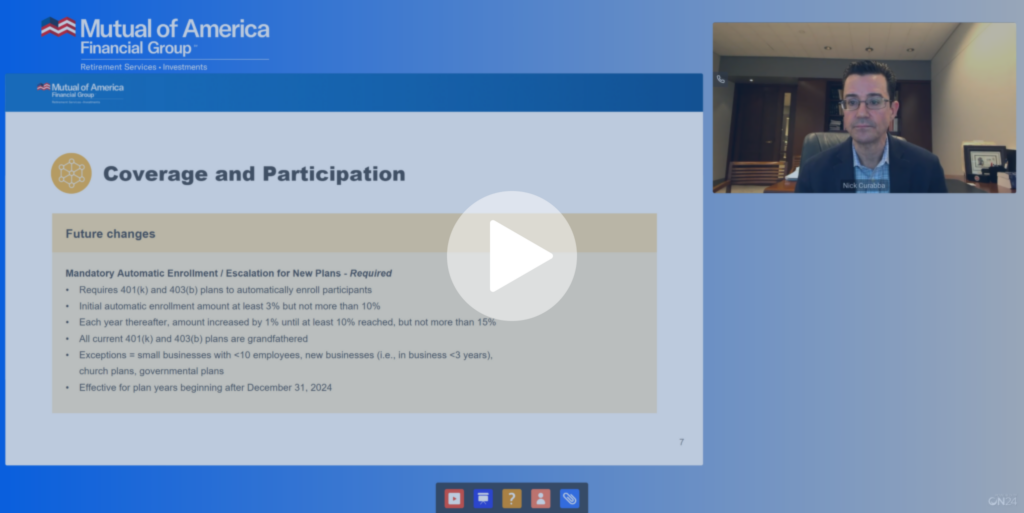
On February 23, Mutual of America Financial Group held an informative webinar on the recently enacted SECURE 2.0 Act of 2022. With featured speakers Nick Curabba, Senior Vice President and Associate General Counsel, and Tyrone Golatt, Executive Vice President, Eastern U.S. Region; and moderator Kieran O’Dwyer, Vice President, Corporate Communications, the session focused on key provisions for 2023 and in the years ahead.
Click here to watch a replay of “SECURE 2.0 Act: What Plan Sponsors Need to Know” for:
- A quick background into the broad, bipartisan legislation that was signed into law at the end of 2022.
- Updates to coverage and participation, contributions, distributions and plan administration that are taking effect this year and those that will take effect in subsequent years.
- What plan sponsors can expect from Mutual of America for help staying updated on additional communications, regulatory guidance and any plan amendments.
Better your tomorrow.
Contact your Mutual of America representative today.
Saver’s Credit for 2023: Potential Tax Relief for Your Employees

Increased income limits for the Retirement Savings Contributions Credit, also known as the Saver’s Credit, could help your employees with a tax credit for contributing to their workplace retirement plan this year.1
Save now, earn a tax credit later
The credit, which is equal to 50%, 20% or 10% of annual eligible contributions to a qualified retirement plan, is dependent on income limits based on a taxpayer’s adjusted gross income and filing status.2 The maximum contribution amount that may qualify for the credit is $2,000 ($4,000 if married filing jointly), making the maximum credit $1,000 ($2,000 if married filing jointly).3
2023 Saver’s Credit
| Credit Rate | Married Filing Jointly | Head of Household | All Other Filers* |
| 50% of your contribution | AGI not more than $43,500 | AGI not more than $32,625 | AGI not more than $21,750 |
| 20% of your contribution | $43,501–$47,500 | $32,626–$35,625 | $21,751–$23,750 |
| 10% of your contribution | $47,501–$73,000 | $35,626–$54,750 | $23,751–$36,500 |
| 0% of your contribution | More than $73,000 | More than $54,750 | More than $36,500 |
Source: IRS.gov
Who’s eligible?3
Employees are eligible for the credit if they are:
1. Age 18 or older;
2. Not claimed as a dependent on another person’s return; and
3. Not a student.
2022 tax returns
There’s still time for employees to take advantage of the credit for last year if they haven’t already filed their 2022 taxes.3 (Note: Qualifying income limits for the 2022 Saver’s Credit are lower than this year’s.) The deadline for filing 2022 tax returns is
April 18, 2023.4
If you or your employees have questions about the Saver’s Credit or have other retirement planning questions, please call your local Mutual of America representative today.
Sources:
1https://www.irs.gov/newsroom/save-for-retirement-now-get-a-tax-credit-later-savers-credit-higher-limits-can-help-low-and-moderate-income-workers-save-more-in-2023
2https://www.irs.gov/taxtopics/tc610
3https://www.irs.gov/retirement-plans/plan-participant-employee/retirement-savings-contributions-savers-credit
4https://www.irs.gov/newsroom/irs-sets-january-23-as-official-start-to-2023-tax-filing-season-more-help-available-for-taxpayers-this-year
Better your tomorrow.
Contact your Mutual of America representative today.
Sources:
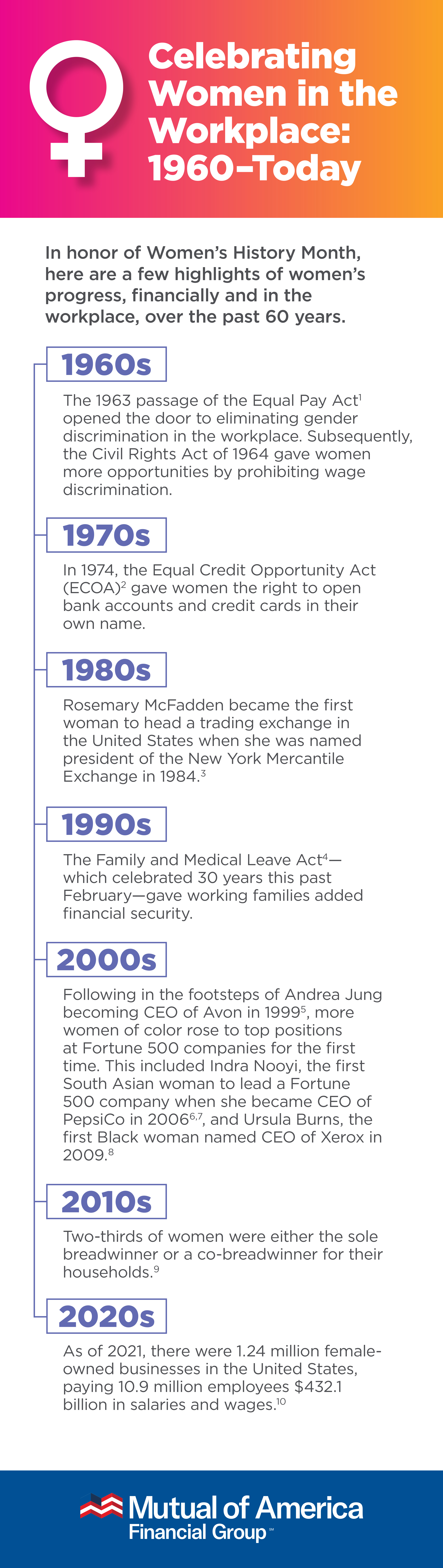
1Equal Pay Act of 1963 | U.S. Equal Employment Opportunity Commission (eeoc.gov)
2Equal Credit Opportunity Act | Federal Trade Commission (ftc.gov)
3Rosemary T. McFadden | FIA
4H.R.770 – 101st Congress (1989-1990): Family and Medical Leave Act of 1990 | Congress.gov | Library of Congress
5Andrea Jung | National Center for Women & Information Technology (ncwit.org)
6Is work-life balance possible at the top? (economist.com)
7Indra Nooyi | National Women’s History Museum (womenshistory.org)
8I’m Here Because I’m As Good As You” (hbr.org)
9Breadwinning Mothers Are Critical to Families’ Economic Security – Center for American Progress
10Census Bureau Releases New Data on Minority-Owned, Veteran-Owned and Women-Owned Businesses
Things
to know
1
5 years
Approximately how long all wage and salary workers age 25 or older have stayed at a job. (This figure has not changed in 40 years.)
Source: EBRI. Trends in Employee Tenure, 1983–2022. January 19, 2023.
2
2025
The year part-time employees will be eligible to participate in their employer’s 401(k) plan if they’ve worked at least 500 hours per year for two consecutive years.
Source: Secure 2.0 Act, Section 125.
3
“Take-up rate”
The percentage of workers with access to a workplace retirement plan who participate in the plan. As of March 22, the take-up rate for private industry workers with defined contribution plans was 73%.
Source: Bureau of Labor Statistics, The Economics Daily. Feb. 1, 2023.