
September 2023
Plan Sponsor News
Welcome to the September 2023 issue of Plan Sponsor News! In this quarterly issue, we provide tips for better cybersecurity, provide information on how your employees can plan for retirement across career stages, and discuss how caregiving can affect participant’s financial health.
Help Your Employees Plan for Retirement at Any Stage of Their Careers

In honor of National Retirement Security Month, here are a few tips to share with your employees to help them build a brighter financial future wherever they happen to be in their careers.
Early Career
While the thought of retirement, let alone saving for it, may not be on their radar given day-to-day expenses (including student loans), younger workers who participate in their workplace retirement plan have an advantage: time.
Starting to consistently save even a small amount now could reduce the need to save greater amounts later, thanks to the power of compounding.
Mid-Career
Employees at the middle stage of their careers could be feeling pulled in multiple directions financially, making it challenging to focus on retirement.But keeping the savings momentum going is key.
Opting in to features like auto-escalation can help employees up their contributions to their 401(k) or 403(b) automatically as their salary increases. And workers who’ve maxed out their contributions may be able to further reduce their taxable income by opening a traditional IRA. This can help them save up to an additional $6,500 in 2023. Another option to consider may be opening a Roth IRA, which offers tax-free growth and tax-free withdrawals in retirement.
Some employees may think about withdrawing funds from their retirement savings plans to cover unexpected expenses, but they should understand the ramifications of doing so. In addition to chipping away at hard-earned savings, they may be responsible for paying taxes and perhaps even costly penalties on the amount they withdraw, which is why most experts recommend not touching that money until retirement.
Later Career
Employees later in their careers or nearing retirement may have lots of questions and challenges. One way to be more prepared is to take advantage of catch-up contributions. In 2023, employees over age 50 can contribute an additional $7,500 per year to a 401(k) or 403(b) for an annual total of $30,000. It’s suggested that employees try to save at least 20% of their income at this stage.
Employees who’ve changed jobs in the past may have money in a retirement account from a previous employer. They may want to consider rolling these funds into their current workplace plan or into an IRA to potentially reduce fees and make managing their assets easier.
Talk to your local Mutual of America representative to learn more about helping your employees achieve their retirement goals.
Better your tomorrow.
Contact your Mutual of America representative today.
Best Practices for Better Cybersecurity

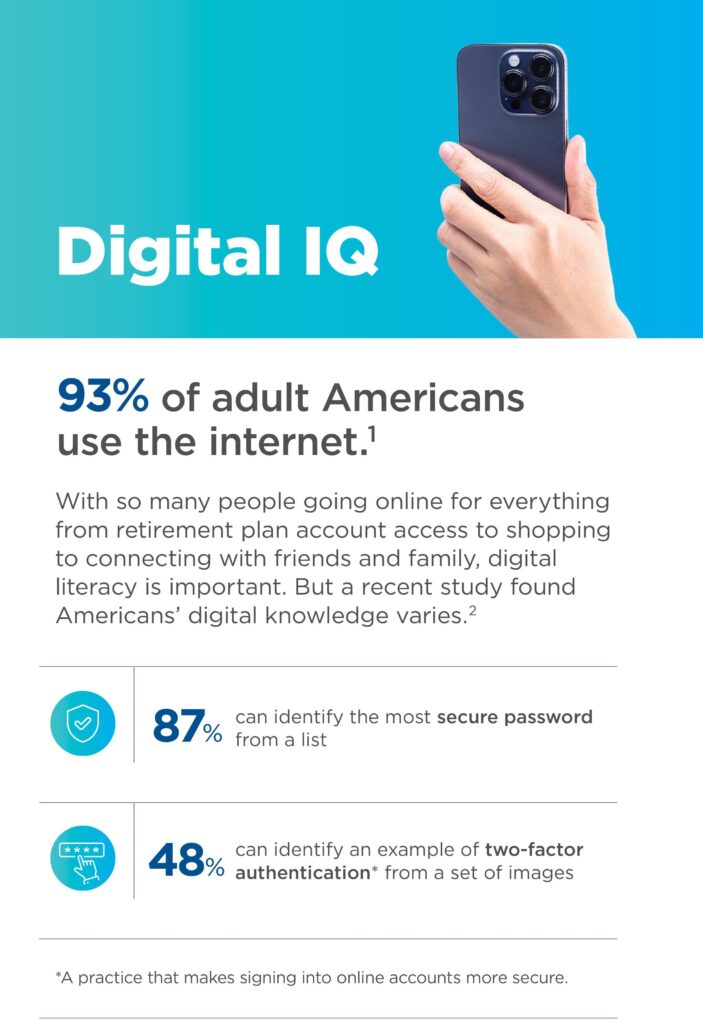
Cybersecurity is about protecting your organization and the services your employees rely on—as well as safeguarding their personal, confidential records and information. With October recognized as Cybersecurity Awareness Month, it’s a good time to review best practices and tips that you and your employees can use to reduce fraud and loss to retirement accounts.
- Regularly check your retirement accounts.
Part of safeguarding your retirement savings is as simple as checking any accounts you may have. For example, access your retirement savings account periodically to verify that the amount in your account and your personal information—including your name, email and street address—are correct. - Use multifactor authentication.
As part of Mutual of America’s ongoing commitment to protecting our customers’ accounts and personal information, we have further strengthened the log-in procedures required for access to the My Account section of mutualofamerica.com. Individuals with accounts need to establish multifactor authentication when logging in to My Account. This process only takes a few minutes, and it includes establishing a username and password (if you haven’t already) with at least one of four security factors, which you can choose to receive via the Okta Verify mobile app, text message or email, or by following voice call instructions. Multifactor authentication helps ensure that only you are accessing your online account information. This is one of the ways we ensure that we are adhering to today’s cybersecurity best practices. - Be savvy with your passwords and internet connection.
Make your passwords as strong as possible, don’t use the same passwords across multiple sites, and keep them confidential. Do not share your passwords with anyone. You should also try to avoid public Wi-Fi, as hackers can more easily intercept the passwords you type in—along with any other personal information you enter—when you’re using an unsecured internet connection. - Be aware of who you’re speaking to.
You should not respond to any form of communication from, or provide any personal information to, unverified parties. Be wary of recipients requesting any money or personal information; for example, individuals claiming to be from the IRS have called stimulus check recipients requesting money or personal information, leading (in some cases) to tax-related fraud and identity theft. Your retirement account savings are also vulnerable to these sorts of attacks. A good way to prevent theft is to avoid responding to unsolicited or untrustworthy communications. If you have questions related to protecting your retirement account, please don’t hesitate to contact your local Mutual of America representative.
Better your tomorrow.
Contact your Mutual of America representative today.
The Rise of Caregiving and its Impact on Your Employees’ Financial Health

Chances are, there are employees in your organization who find themselves in a caregiving role outside of the workplace.
According to the National Alliance for Caregiving (NAC) and AARP, approximately one in five adults in the U.S. are providing unpaid family care either full-time or part-time to another adult (often a senior parent or relative) or to a child with disabilities. And the Employee Benefit Research Institute’s (EBRI) 2023 Retirement Confidence Survey Caregivers Report found that 21% of participants in workplace retirement plans are caregivers.1 This additional responsibility can impact an employee’s financial well-being, ability to save and outlook for retirement.
Confidence and saving for retirement
While caregivers are just as likely as non-caregivers to have done various retirement preparation tasks2 and understand the investments available to them in their workplace retirement plans,3 caregivers express less confidence about retirement, according to the EBRI report. In fact, 57% say they feel very or somewhat confident in having enough money to live comfortably in retirement, compared to 67% of non-caregivers.4
What’s more, caregivers are less likely to say they’re confident they’ve done a good job preparing financially for retirement compared to their non-caregiver counterparts (61% vs. 68%).5 More than half (52%) say their caregiving responsibilities have had a negative impact on their ability to save for retirement,6 and 20% have reduced their retirement plan contributions as a result of their role.7
Support in preparing for retirement
With two-thirds of all employees saying preparing for retirement makes them feel stressed,8 providing support and education is critical.
Of those workers who made a change to their workplace retirement plan in the past year, 14% of caregivers used a tool or calculator to determine how to generate income from their savings, compared to 8% of non-caregivers.9
And 28% of caregivers ranked one-on-one assistance with consolidating other retirement savings balances into their current plan as among the most valuable improvements to their employer-sponsored retirement plan, compared to 18% of non-caregivers.10
Contact your local Mutual of America representative for ways to help your employees feel more secure in preparing for retirement.
1EBRI and Greenwald Research 2023 Retirement Confidence Survey Caregivers Report, July 2023, p. 9.
2EBRI and Greenwald Research, EBRI Issue Brief: Caregivers and Retirement: Findings From the 2023 Retirement Confidence Survey, no. 586, July 2023, p. 35, fig. 43
3EBRI and Greenwald Research, EBRI Issue Brief: Caregivers and Retirement: Findings From the 2023 Retirement Confidence Survey, no. 586, July 2023, p. 40, fig. 50.
4EBRI and Greenwald Research, 2023 Retirement Confidence Survey Caregivers Report, July 2023, p. 13.
5EBRI and Greenwald Research, 2023 Retirement Confidence Survey Caregivers Report, July 2023, p. 46.
6 EBRI and Greenwald Research, 2023 Retirement Confidence Survey Caregivers Report, July 2023, p. 43.
7 EBRI and Greenwald Research, 2023 Retirement Confidence Survey Caregivers Report, July 2023, p. 42.
8 EBRI and Greenwald Research, 2023 Retirement Confidence Survey Caregivers Report, July 2023, p. 54.
9 EBRI and Greenwald Research, 2023 Retirement Confidence Survey Caregivers Report, July 2023, p. 69.
10 EBRI and Greenwald Research, 2023 Retirement Confidence Survey Caregivers Report, July 2023, p. 76.
Better your tomorrow.
Contact your Mutual of America representative today.
Sources:
1Pew Research Center, Internet/Broadband Fact Sheet, April 7, 2021. https://www.pewresearch.org/internet/fact-sheet/internet-broadband/
2Pew Research Center, “What Americans Know About AI, Cybersecurity and Big Tech,” Aug. 17, 2023. https://www.pewresearch.org/internet/2023/08/17/what-americans-know-about-ai-cybersecurity-and-big-tech/
Things
to know
1
November 6, 1978
November 6 marks the 45th anniversary of Congress passing the Revenue Act of 1978, which added Section 401(k) to the Internal Revenue Code, giving employees a tax-free way to defer compensation from bonuses or stock options. This and subsequent legislation paved the way for 401(k) retirement savings plans as we know them today.
Source: Revenue Act of 1978, Section 135(a), p. 23.
2
8 in 10
81% of workers who participate in their workplace retirement plan say it’s a top benefit. And 65% of employees say a retirement savings plan is the most important reason to stay in their current job or choose a new one.
Source: EBRI and Greenwald Research, 2022 Workplace Wellness Survey, p. 6.
3
Employee well-being
Almost one-third of employees (31%) say their employer’s efforts to help manage their overall well-being have increased from the previous year.
Source: EBRI and Greenwald Research, 2022 Workplace Wellness Survey, p. 5.