June 2025
Plan Sponsor News
Welcome to the June 2025 issue of Plan Sponsor News! In this quarterly issue, read about how to assess the health of your retirement plan as well as strategies to increase key benchmarking metrics, how to educate employees on the differences between loans and withdrawals, and the programs honored for their impact on their communities with the Community Partnership Award.

Impacting Benchmarks with Plan Design

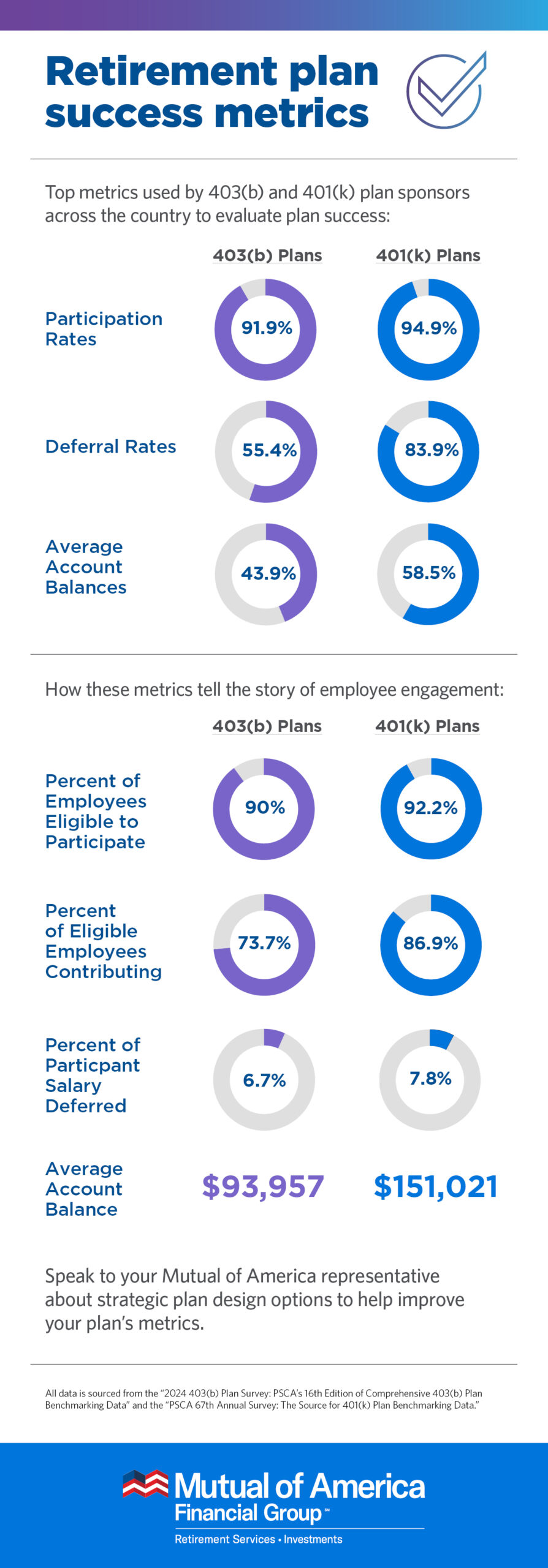
When it comes to evaluating plan success, most employers offering 403(b) and 401(k) plans look to participation and deferral rates, as well as average account balances, according to the latest benchmarking reports from the Plan Sponsor Council of America (PSCA).1
As sponsor of the PSCA’s 2024 403(b) Plan Survey, Mutual of America is committed to helping plan sponsors make the most of their plan and welcomes the opportunity to offer strategic plan design options to impact these three key metrics above. Following are a few ideas centered around engaging employees as early as possible that can help them to start saving earlier, which results in better outcomes and higher balances at retirement. This also helps plan sponsors with employee attraction and retention.
Automatic enrollment
Automatic enrollment arrangements can help engage employees early and bridge the gap between employees who are eligible to participate in the plan and those who do. According to the PSCA surveys, only 73.7% of employees eligible to contribute to a 403(b) plan and 86.9% of 401(k) plan-eligible employees decide to contribute to their plans. Those participation rates could be increased by adopting an automatic enrollment arrangement.
Currently only 35.5% of 403(b) plans and 63.8% of 401(k) plans leverage automatic enrollment. As of 2025, new 401(k) and 403(b) plans are mandated through the SECURE 2.0 Act to automatically enroll employees.2 Established plans may want to do the same. Mutual of America is seeing more employees expecting their employers to automatically enroll them in the plan.
Employer matching contributions
Eligibility for matching contributions can be leveraged as a recruitment tool to help attract new employees and promote plan engagement from day 1.
More than four out of 10 403(b) plans (43.4%) and 401(k) plans (43.8%) allow employees immediate eligibility to receive employer matching contributions. Another 40% of 403(b) plans and 17.8% of 401(k) plans require a year of service before offering matching contributions.
Mutual of America recommends that plan sponsors review eligibility requirements from time to time to ensure alignment with overall benefits and the goals of the organization.
Depending on a plan’s demographics, plan sponsors might also consider offering—and matching—enhanced catch-up contributions for participants aged 60-63. This optional provision of SECURE 2.0 Act gives older employees a chance to boost their savings. For 2025, the enhanced catch-up contribution is $11,250. See information regarding plan adoption in Things to Know.
Investment options
The role of a retirement plan’s investment options on participant engagement shouldn’t be overlooked. Too many funds can make it harder for employees to make selections, and too few may not offer enough for employees who want options. That’s why it’s important to have a good balance and a variety of funds.
On average, 403(b) plans offer 25 investments for participant contributions and 401(k) plans offer 22. Target retirement date funds are the most popular—offered by 84.2% of 401(k) and 89.2% of 403(b) plans. Target-date funds typically serve as the default options. Offering these funds makes it easy for employees who may be less sophisticated to make investment decisions.
Not every target date fund is the same, however, so it’s important to review them. Fees, glide path and performance track record are all things to look at.
Employee education
Making employees aware of the benefits available in their workplace retirement plan is key to engagement. Ideally, they’ll take advantage of features such as an employer match, but education remains key.
Education is probably the most important service employers can offer employees. Saving and investing for retirement can be overwhelming. It’s important for employees to understand the benefits of the retirement plan, how much they should be saving and how they are investing, so they take advantage of what’s available.
In fact, increasing participation and overall financial literacy are the top reasons plan sponsors cite for providing plan education to employees.
Mutual of America offers in-person and virtual one-on-one sessions and educational seminars for participants covering a wide range of financial wellness topics including the basics of investing and action steps for retirement readiness. Contact your Mutual of America representative for more information and support.
1Sources for all stats included are the “2024 403(b) Plan Survey: PSCA’s 16th Edition of Comprehensive 403(b) Plan Benchmarking Data” and the “PSCA 67th Annual Survey: The Source for 401(k) Plan Benchmarking Data.”
2Simple 401(k) plans, governmental plans and church plans are all exempt from this provision. Related startup credit for costs up to $5,000.
Better your tomorrow.
Contact your Mutual of America representative today.
Helping Employees Understand Retirement Plan Loans and Withdrawals

Recent industry reports have shown that more American workers have been tapping into their workplace retirement accounts. According to the Employee Research Benefits Institute, one in five participants have taken a loan or withdrawal in the past year,1 up from one in six the previous year.2
Regardless of the reason or the method, dipping into retirement account funds can negatively impact future savings. Here is information you can share with plan participants thinking about taking a loan or withdrawal to help them understand the difference, as well as the implications of each. More detailed information can be found on the “Withdrawals, Rollovers and Loans” page.
Retirement plan loans vs. withdrawals
When participants take a loan from their retirement savings, they are borrowing against themselves. The full amount would have to paid back with interest over time, usually within five years, even if a participant leaves the organization.
In the case of a withdrawal on the other hand, participants are taking a specific amount of money out of their retirement plan permanently. They won’t be able to pay this money back, and it’s usually taxed as income.
Considerations and consequences
- Penalty tax: If a participant making a withdrawal is under 59½ years of age, an extra 10% income tax may apply.
- Less money at retirement: Funds removed from the retirement plan account won’t benefit from compounding, inhibiting growth over time.
Alternate bucket of savings
To help your participants avoid taking retirement plan loans or withdrawals, consider encouraging them to set up an emergency fund. Mutual of America offers educational seminars, such as Budgeting 101, designed to strengthen participants’ financial knowledge and support their financial futures. Contact your Mutual of America Participant Account Specialist for more information.
1EBRI 2025 Retirement Confidence Survey, page 9.
2EBRI 2024 Retirement Confidence Survey, page 70.
Better your tomorrow.
Contact your Mutual of America representative today.
The 2024 Mutual of America Foundation Community Partnership Award

Mutual of America recently marked the 29th anniversary of its Community Partnership Award, a prestigious competition that celebrates the transformative work of nonprofit organizations across the United States. This year, programs were honored for their measurable impact on their communities and their innovative approaches to addressing evolving challenges.
This annual award aligns with Mutual of America’s commitment to social responsibility and highlights the power of partnerships between nonprofit, public, private and social sector organizations.
Thomas J. Moran Award
This year’s Thomas J. Moran Award was given to Hudson Link for Higher Education in Prison in Ossining, NY. Hudson Link works with local colleges, universities and correctional facilities to provide higher education opportunities, life skills and reentry support for currently and formerly incarcerated individuals. The organization’s impact is proven by a recidivism rate under 2% for program graduates. Watch their inspiring story in this documentary.
Frances R. Hesselbein Award
This award was presented to iFoster, Inc. in Truckee, CA, for its Community Health program, which is dedicated to giving foster children the resources and opportunities they need to become successful, independent adults.
Four additional programs received Social Impact Awards for their meaningful contributions:
- Black Home Initiative (Seattle, WA)
- The Tennessee Center for Decision-Making Support (Nashville, TN)
- Little Readers (Nashville, TN)
“The 2024 Community Partnership Award-winning programs exemplify the spirit of partnership and innovation that drives meaningful change in communities across the country,” said Sara Wiencken, Chair of the Mutual of America Foundation. “Their work is transformative for the individuals and families they serve and a model for how sectors can come together to create beneficial change.”
Better your tomorrow.
Contact your Mutual of America representative today.
Things
to know
1
New Reports Available in the Plan Sponsor Portal
We are pleased to announce additional on-demand plan reports are now available for some of our group retirement clients. If your plan permits loans, the Loan Overview report provides general information about loans taken within your plan, such as status, issue date and payment information. Similarly, if your plan is administered using a vesting schedule and generates forfeitures, the Forfeiture Summary and Transaction Report provides a detailed record of all activity in your forfeiture account. Please reach out to your local Client Service Representative (CRM) for more information.
2
Enhanced Catch-up Contribution Capability Added to Plans
This optional provision of the SECURE 2.0 Act for 2025 builds on the catch-up contribution for individuals aged 50 and above (the “age 50 catch up”). It allows people turning 60 through 63 years of age in a year to contribute even more. For plans allowing the age 50 catch-up, the enhanced catch-up provision will be enabled automatically, and the same matching designation will be applied. If you wish to opt-out of the enhanced catch-up or change your matching designation, reach out to your CRM by June 30.
3
July Plan Year Compliance Calendar Available
An ERISA Compliance Calendar for July defined contribution-type plan years is now available on our website (along with the calendar for January plan years). The calendar spotlights important deadlines in 2025.
4
Apply for the Community Partnership Award by July 1
Applications are being accepted for the 2025 Mutual of America Foundation Community Partnership Award competition through July 1. To be considered for an award, an organization must show exemplary leadership by facilitating partnerships with public, private or social sector leaders for the benefit of their communities. An independent committee selects the winners. Apply today.
5
403(b) Benchmarking Opportunity with PSCA
Mutual of America Financial Group is proud to again be the sole sponsor of this year’s Plan Sponsor Council of America’s (PSCA) 403(b) plan survey. The resulting report is an independent source of 403(b) plan benchmarking data. Complete the survey and receive a copy of the results.