September 2025
Plan Sponsor News
Welcome to the September 2025 issue of Plan Sponsor News! In this quarterly issue, read about fulfilling your fiduciary duties with confidence, preparing for key SECURE 2.0 Act provisions and helping your employees understand the difference between traditional and Roth contributions.

Help for Navigating Your Fiduciary Duties with Confidence

Navigating fiduciary duties may feel overwhelming. As a plan sponsor, you carry out important responsibilities in accordance with the Employee Retirement Income Security Act (ERISA), or state laws, which are designed to protect your employees. You can read comprehensive information about fiduciary responsibilities in the U.S. Department of Labor’s Employee Benefits Security Administration (EBSA) booklet, Meeting Your Fiduciary Responsibilities.
However, you don’t have to navigate fulfilling these fiduciary duties alone. Mutual of America offers support, from our annual plan review process to objective benchmarking analysis of total plan, investment and recordkeeping fees, all coordinated through your Client Relationship Manager (CRM).
Before we start exploring some of your responsibilities, it is important to note that according to the EBSA booklet, “Hiring a service provider in and of itself is a fiduciary function.” In other words, employers cannot fully delegate their fiduciary responsibilities under ERISA by appointing an external provider; the decision to hire such a provider is itself a fiduciary act. Consequently, employers must exercise due diligence in both selecting their providers and monitoring their performance.
Here’s a look at three important fiduciary responsibilities and how we help you with monitoring and documentation.
Following the terms of the plan document
Our annual plan review process can help you make sure you are following the terms of your plan document.
According to the EBSA booklet, “Following the terms of the plan document is … an important responsibility. The document serves as the foundation for plan operations. Employers will want to be familiar with their plan document, especially when it is drawn up by a third-party service provider, and periodically review the document to make sure it remains current.”
Your CRM is happy to conduct regular plan reviews with you, during which the following items are discussed:
- Plan provision reviews (to help you make sure you are following your plan documents and to discuss required or desired amendments)
- Fee benchmarking
- Investment reviews
- Operational and compliance reviews
- Pertinent legislative and regulatory updates
- Plan health and participant analysis
Paying only reasonable plan expenses—a closer look at the Benchmark Fee Report
Our Benchmark Fee Report covers total plan cost, investments and recordkeeping compared to plans of similar size.
According to the EBSA booklet, “While the law does not specify a permissible level of fees, it does require that fees charged to a plan be ‘reasonable.’ After careful evaluation during the initial selection, the plan’s fees and expenses should be monitored to determine whether they continue to be reasonable.”
When considering plan fees, EBSA makes clear that sponsors are not obligated to choose the lowest-cost provider, but rather to determine whether the fees are reasonable and offer good value compared to the services being received. In comparing estimates from service providers, it’s important to understand which services are covered for the estimated fees and which are not. Some providers, such as Mutual of America, offer a “bundled approach.”
Selecting and monitoring the investment alternatives that are made available under the plan—a closer look at the Quarterly Investment Fund Benchmarking Report
We make available to you a quarterly benchmarking report to assist you in fulfilling your fiduciary duties regarding monitoring the investment options offered through your plan.
Your CRM can provide you with an investment benchmarking report prepared by the investment professionals at 320 Park Analytics LLC.1 The report provides an overview of investments, benchmark performance comparisons, peer group comparisons and fees and expenses.
Of course, these are only some of the fiduciary duties that come with operating a plan. In the December 2024 Plan Sponsor News article “Plan Sponsors: How to Set Yourself Up for Success in the New Year,” we discussed some common mistakes that plan sponsors make and how we can help you to avoid them.
If you have any questions regarding your fiduciary duties, we are knowledgeable and here to help. Reach out to your CRM with any questions.
1320 Park Analytics LLC is a subsidiary of Mutual of America Life Insurance Company and is not a broker-dealer or investment adviser.
Better your tomorrow.
Contact your Mutual of America representative today.
SECURE 2.0 Act: What You Need to Know to Prepare for 2026

With 2026 around the corner, plan sponsors should be aware of and prepared for the implementation of several SECURE 2.0 Act-related provisions.
As you may know, the SECURE 2.0 Act was signed into law in December 2022 and expanded upon the SECURE Act of 2019 by continuing to pursue the objective of broadening the appeal of workplace retirement plans. Many of the provisions of the act needed to wait for regulatory guidance from both the IRS and the Department of Labor (DOL).
Here’s a visual overview of the SECURE Act provision timeline highlights that we’ll be discussing.
| 2019 | 2025 | 2026 |
| Long-Term, Part-Time (LTPT) Workers: 401(k) plans must allow employees who worked at least 500 hours for three consecutive years to make elective deferrals beginning with the first plan year on or after January 1, 2024. | LTPT Workers: The LTPT rule adopted in 2019 expanded in SECURE 2.0 to include ERISA-covered 403(b) plans. In addition, the three-year trigger was reduced to two years. | The general amendment deadline for qualified plans is December 31, 2026. (Collectively Bargained Plans: December 31, 2028. Governmental Plans: December 31, 2029.) Roth Catch-Up Contributions: For those plans allowing catch-ups, catch-up contributions must be made on a Roth basis for those with incomes over $145,000 in the prior year. |
Plan amendment deadline—December 31, 2026
As you may recall from our “SECURE 2.0 Act: What’s coming in 2025” webinar, in what is referred to as the “grab bag guidance,” the IRS and DOL provided guidance in December 2023 on many different provisions in the SECURE 2.0 Act. The key takeaway from that grab bag guidance was the plan amendment deadline.
Under the original SECURE 2.0 Act, plans would have had to adopt amendments to come into compliance with the mandatory provisions of the legislation by the end of 2024. The IRS pushed that out even further for most plans (with the exception of governmental plans and plans that are subject to collective bargaining agreements) until the end of 2026.
Catch-up contributions as Roth for certain high earners1
Starting in 2026, those aged 50 or older who earned over $145,000 in FICA wages2 (indexed annually for inflation) in the previous year from the same employer, are required to make any catch-up contributions on an after-tax Roth basis.
- Starting with plan year 2026, any catch-up contributions for certain high earners must be made on a Roth basis.
- By the end of calendar year 2026, plan sponsors will need to review and amend their plan documents to reflect the Roth catch-up requirements and any related changes. They will also need to update their Summary Plan Descriptions (SPDs).
- Note: By the 2026 deadline, Mutual of America will amend plan documents and subsequently provide SPDs to plan sponsor clients to whom we provide document services.
Related to this provision, the SECURE 2.0 Act also eliminated the requirement for required minimum distributions (RMDs) from Roth accounts within employer-sponsored plans beginning in 2024.
If your plan doesn’t currently allow for Roth contributions, employees eligible for catch-ups (i.e., those age 50 and up) will not be permitted to make catch-up contributions if they made more than $145,000 in wages in the prior year. If you’d like to add a Roth feature to your plan so that they can continue to make catch-up contributions, contact your CRM now to amend your plan to allow for Roth contributions.
LTPT worker eligibility
Broadly speaking, the LTPT worker provision ensures that part-time employees can have access to retirement plans. Prior to the enactment of the SECURE Act of 2019, 401(k) plans were required to offer coverage to all employees age 21 and older who worked at least 1,000 hours in one year. Beginning with the first plan year on or after January 1, 2024, the act changed that rule for 401(k) plans to require that all employees who worked at least 500 hours for three consecutive years be given the opportunity to make elective deferrals to the plan.
The SECURE 2.0 Act broadened the LTPT provision by lowering the number of years for part-time workers to be eligible from three years to two years and expanding coverage to 403(b) plans subject to ERISA. As discussed above, for most plans, the amendment date for this provision has been extended to the end of the 2026 plan year.
For specific questions about the LTPT provision, read our Frequently Asked Questions.
Next steps
We will continue to keep you informed of the implementation of these provisions and related amendments. Please reach out to your CRM with questions.
1Catch-up contributions as Roth for certain high earners applies to 401(k), 403(b) and governmental 457(b) plans.
2Federal Insurance Contributions Act (FICA) wage refers to the portion of an employee’s earnings subject to Social Security and Medicare taxes.
Better your tomorrow.
Contact your Mutual of America representative today.
Traditional vs. Roth Contributions: Helping Employees Understand the Difference

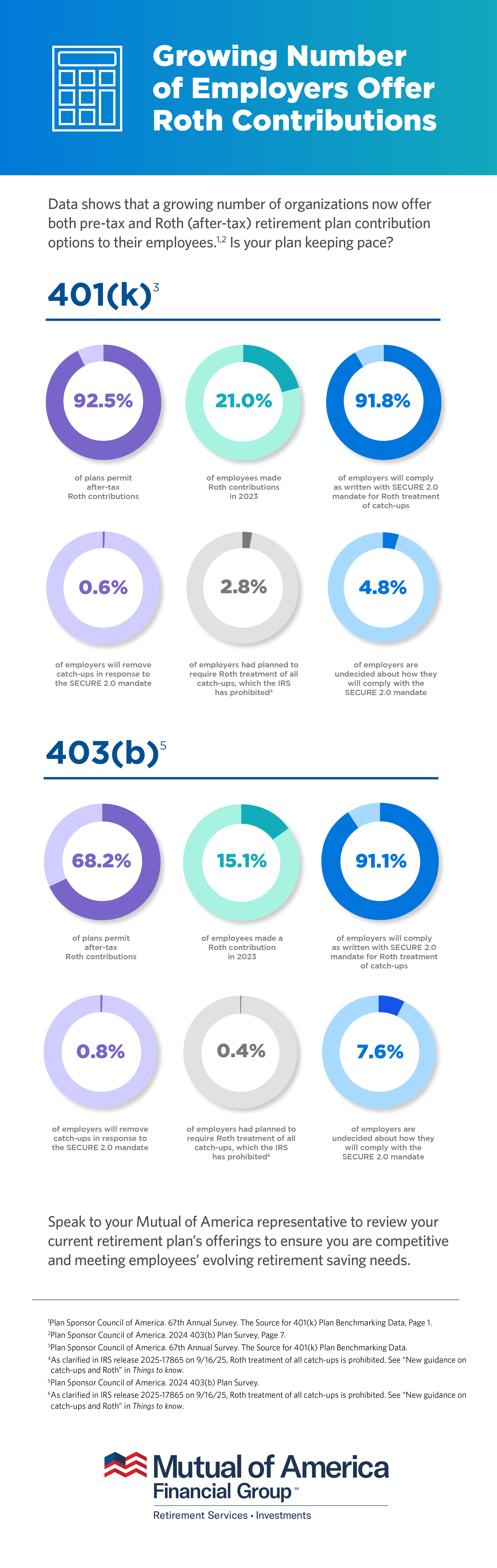
Plan sponsors can support employees’ financial futures by helping them understand the contribution options available within their workplace retirement plans. This breakdown may help participants make more informed decisions about diversifying pre-tax and Roth contributions.
What’s the difference between traditional and Roth contributions?
Many 401(k) and 403(b) plans offer two ways to contribute: traditional (or pre-tax) and Roth (or after-tax). The best option depends on an employee’s current financial situation, expected future income and tax bracket.
Traditional contributions (pre-tax)
- Deducted from a participant’s paycheck before income taxes are applied
- Lowers a participant’s current taxable income, which can mean a smaller tax bill today
- Contributions and earnings grow tax-deferred until distribution
- Taxed as income in retirement when a participant withdraws the money
- Required minimum distributions begin later at the age of 73
Roth contributions (after-tax)
- Deducted from a participant’s paycheck after income taxes have been taken out
- Do not reduce a participant’s current taxable income
- Withdrawals of both contributions and earnings are tax-free in retirement if certain conditions are met (e.g., if a participant is age 59½ and has held the account for 5 years)
- No required minimum distributions
Roth in workplace retirement plans
If the plan allows, participants can choose to split their elective deferrals between pre-tax and Roth contributions. Opting for the Roth provision could help participants build future tax-free income.
Tax strategies can be complex, so we recommend participants consult an adviser. In very general terms, below are reasons why high earners and young workers may want to choose to diversify with a percentage of Roth contributions, as well as reasons why some employees may want to stay with traditional contributions.
What are some reasons why employees may want to diversify with Roth contributions?
- Tax-free retirement income: The core advantage is that participants and their beneficiaries can withdraw their savings entirely free of federal income tax during retirement, provided certain conditions are met. This eliminates uncertainty about future tax rates.
- Tax diversification: By having both traditional (pre-tax) and Roth (after-tax) retirement accounts, participants gain flexibility in retirement. They can strategically withdraw from different accounts to manage taxable income.
- No RMDs: As of 2024, Roth contributions within plans no longer have RMDs for the original account owner. This allows money to continue growing tax-free for life, and it can be used as an estate planning tool for leaving tax-free assets to heirs.
- No income thresholds: High earners (modified adjusted gross income of more than $165,000) generally cannot make current contributions to a Roth IRA. However, there are no income limits on eligibility for in-plan Roth contributions.
Why might workers early in their careers consider Roth contributions?
- Young people early in their careers: Entry-level salaries likely place employees in a low tax bracket. By paying taxes now, they can watch their savings grow tax-free over many decades, likely withdrawing funds tax-free when they are in a higher tax bracket.
What are some reasons to stay with traditional (pre-tax) contributions only?
- High earners expecting a lower tax bracket in retirement: If a participant is currently in a high tax bracket and expects a lower income after working, the upfront tax deduction from a traditional contribution may provide more value.
- Savers who need the immediate tax break: Some employees may prefer to lower their current tax bill by taking the upfront deduction, which can increase their current take-home pay.
- Older workers closer to retirement: For those with a shorter time horizon, the tax-free growth of a Roth amount may not have as much time to compound and outweigh the benefit of an immediate tax deduction.
Ask your Participant Account Specialist about our Traditional vs. Roth Contributions Workshop.
Better your tomorrow.
Contact your Mutual of America representative today.
Things
to know
1
Deferral change and beneficiary reports available from dashboard
Deferral change and beneficiary reports are now live in the Plan Sponsor Dashboard under the “Plan Reports” section. The deferral change report provides plan sponsors with on-demand, custom-date reporting on participant deferral changes. It can be downloaded in Excel, like other dashboard reports, and displays participant name, deferral rate changes (prior and current elections) and the deferral change effective date. Changes are shown in percent (%) and dollar ($) amounts, as applicable, depending on plan rules and participant elections.
The beneficiary report provides on-demand visibility for plan sponsors into participant beneficiary elections, offering flexible filtering options, including options to view all participants, to view whether they have elected beneficiaries or not, show only participants with elected beneficiaries, including beneficiary details, and to view only participants without elected beneficiaries.
2
New guidance on catch-ups and Roth
The Department of the Treasury and the Internal Revenue Service issued final regulations addressing several SECURE 2.0 Act provisions relating to catch-up contributions on September 15. The final regulations include rules related to a SECURE 2.0 Act provision requiring that catch-up contributions made by certain higher-income participants be designated as after-tax Roth contributions, and to the enhanced catch-up for participants aged 60-63. While the final regulations generally follow the proposed regulations, changes were made in response to comments received on the proposed regulations, including guidance on corrections for a failure to comply with the Roth catch-up requirement. Look for a Bulletin from us with more details soon.
3
Reminder: Upcoming extended deadline for Form 5500 filings for January plan years
For a plan year that ends on December 31, the extended deadline to file Form 5500 is October 15. The extension is automatically granted for two and a half months for sponsors that file a Form 5558 by the original deadline of July 31.
4
Reminder: Take advantage of cash-out limit increases and potentially avoid an audit
In September 2024, we discussed how your organization could streamline your plan administration and potentially avoid an audit by taking advantage of the involuntary cash-out provision for 401(k) and 403(b) plans. The cash-out increase—from $5,000 to $7,000—went into effect in 2024 as part of the SECURE 2.0 Act. Mutual of America offers an enhanced involuntary distribution solution designed to streamline small-balance rollovers. Reach out to your CRM to discuss whether this solution is right for your plan.
5
MoA Clear Passage Target-Date Funds™ named top performers
Mutual of America Capital Management LLC recently had five of its MoA Clear Passage Target-Date Funds highlighted in the article “Best Target-Date Funds: Top Funds For Retirement Investors” by Bankrate.com. “We are always pleased to see our MoA Clear Passage Funds receive the attention they deserve, especially given our commitment to generating outstanding investment results for our shareholders,” said Joseph Gaffoglio, President and CEO of Mutual of America Capital Management. “The target date series is guided by a disciplined approach and long-term investment focus, which is reflected in their strong performance over time.”
6
Joe Gaffoglio featured in WealthManagement.com
Joseph Gaffoglio, President and CEO, Mutual of America Capital Management LLC, was recently featured in WealthManagement.com. Joe highlights the resilience of the U.S. financial markets and economy during 2025, along with key issues that investors should keep an eye on in the months ahead, such as inflation and the labor market. Read these articles and gain insights from our investment professionals:
“2025 Midyear Outlook – Markets and Economy Resilient Amid Uncertainty,” by Joseph Gaffoglio, President and CEO, Mutual of America Capital Management LLC
“Economic & Market Perspective – August 2025,” by Jamie Zendel, EVP, Head of Quantitative Strategies, Mutual of America Capital Management LLC
7
Executive order to expand access to alternative assets
On August 7, 2025, President Donald Trump signed an executive order (the “Order”) entitled “Democratizing Access to Alternative Assets for 401(k) Investors,” which aims to expand investment options for Americans participating in defined-contribution retirement plans. The Order could give retirement plan participants access to “funds that include investments in alternative assets” if “the relevant plan fiduciary determines that such access provides an appropriate opportunity for plan participants and beneficiaries to enhance the net risk-adjusted returns on their retirement assets.” The DOL has 180 days to reexamine its past and present guidance. We will provide more information as it becomes available.